You have tried it already. A client deck is due, so you open ChatGPT or Claude, describe what you need, and watch it get you about 30 percent of the way there. Then you spend the days to weeks fixing the logic, correcting the numbers, and rebuilding the structure so it holds up in front of a client. The AI was fast. It just was not built for the work.
That gap is the real story of AI tools for consultants in 2026. The intersection of AI and consulting has moved fast, and there is no shortage of tools. The question is which ones actually fit the way consultants operate and an actual client engagement runs, from the first proposal to the final readout, and which ones leave you doing the hard part by hand.
This is a practical comparison of the main options consultants reach for today, what each is genuinely good at, and where each falls short for professional consulting work.
What “the best AI tools for consultants” actually means
Most “best AI tools” lists rank by popularity and narow use cases. That misses the point for consulting. The work has a specific process: you frame an ambiguous problem, gather and interrogate data, build a defensible argument, align stakeholders, and deliver something a client will pay for and act on. Every output along the way has to survive scrutiny in the room.
So the real test is not “can this AI run research” or “can this tool make a nice slide.” It is whether the tool can carry rigor across the full workflow of an engagement. Hold each option below against that bar.
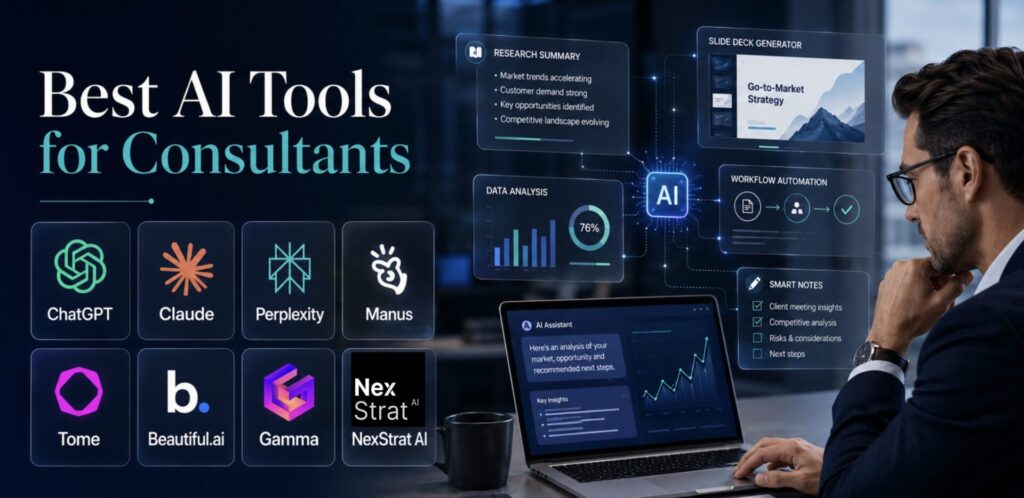
Here is how the main categories compare at a glance.
| Tool Category | Examples | Best for | Consulting Limitations |
| Generic AI (chat focus) | ChatGPT, Claude, Gemini | Drafting, summarizing, unstructured research, analysis and ideation | No structured consulting workflow or tools, you structure everything yourself with painful iterations |
| Generic agentic platforms | Manus | Autonomous multi-step task execution | Not trained on consulting method; output is hard to defend |
| AI presentation makers | Gamma, Canva, Beautiful.ai | Fast, visually rich, designed slides | No consulting-grade, professional slides, generated from a prompt, not from real analysis |
| AI research tools | Perplexity | Fast, sourced first-pass research | Limited context, no proper synthesis, or translation to strategies and action plans |
| Manual tools (partial AI co-pilot support) | Powerpoint, Excel | Fully hands-on control | Slow; output capped by your hours |
| Purpose-built Consulting AI Tools | NexStrat AI | The full consulting workflow with specialized agents and consulting frameworks, from proposal to deck | Free from limitations of other tools as built for business strategy, transformation and consulting specifically rather than general use |
Try NexStrat for free: See AI agents solve your real client case and get your free consulting deck today.
Generic AI and LLMs: ChatGPT, Claude, and Gemini
General-purpose AI and LLMs are the default starting point for most consultants, and for good reason. ChatGPT, Claude, and Gemini are genuinely excellent at drafting, summarizing, rewording, research and quick brainstorming and analysis. Claude in particular has become a favorite for longer analytical reasoning, while ChatGPT is mainstream. If you need support on an easy task, they are quite practical for getting a quick response or a draft.
The limits show up the moment the work gets structured. A generic AI has no structured access to your consulting knowledbase or the full context of your engagement, no built-in consulting frameworks or prompts, no specialized agents trained for consulting work, and no way to keep a complex analysis and resulting strategic recommendations coherent across many steps. You end up doing the structuring yourself, prompt by prompt, then stitching the outputs together and checking every figure – while getting drowned in unstructured and ever-growing chat threads. For a solo or independent consultant or a consulting firm testing ChatGPT or Claude for actual client work, this is the wall you hit: a brilliant assistant, but a poor engagement partner or a team member.
Use them for what they are good at. Just do not expect a generic AI chatbot or agent to run a structured strategy process or a due diligence review end to end, because that is not what it was built to do.
Agentic AI: Agentic platforms like Manus and LLMs with increasingly agentic capabilities
Agentic tools like Manus, as well as LLMs with increasingly agentic capabilities can now take a goal and execute multi-step tasks on their own. The promise is compelling: hand off a whole task and let the agent run it.
For consulting, the catch is that general agents are exactly that, general. They are not trained on consulting method, they do not start from a hypothesis-driven structure, they have no proprietary knowledge of battle-tested consulting methodologies, and they have no structured, visual framework libraries to draw on. They can chain steps together, but without the underlying rigor of how top firms actually solve problems, the output is unpredictable and hard to defend. Autonomy without method is not an advantage when your name is on the recommendation.
AI presentation makers: Gamma, Beautiful.ai and Canva AI
The deck is where consultants lose the most hours, so the best AI tools for business presentation are an obvious draw. Gamma, Beautiful.ai and Canva AI can turn a prompt or an outline into a clean, designed deck in minutes, and the visual quality is often very good.
The problem is what sits behind the slides. These tools generate presentations from your prompt, not from real analysis. They make the container look professional, but they do not do the thinking, the market sizing, or the competitive analysis that gives a consulting deck its substance. So you still have to do the actual work somewhere else, then feed it in. For a client-ready readout where every claim has to be defensible, a polished slide built on no underlying logic is a liability, not a shortcut.
Great for polish. Not a substitute for the analysis a consulting deck is supposed to carry.
AI research tools: Perplexity and the research layer
Research-focused tools like Perplexity are a real step up for the “gather the evidence” part of the job, and among the better AI tools for market research and analysis. They search the live web, cite sources, and pull together a credible first read on a market, a competitor, or a trend far faster than manual desk research and deeper than general-purpose LLMs.
For consultants, this solves one stage of the engagement well: fast, sourced research. What it does not do is turn that research into a structured argument, a framework-based assessment, or an action plan. You get good inputs, then you are on your own for the synthesis, the structuring, and the recommendation, which is the part clients actually pay for. Research is the opening move, not the whole game.
The traditional approach: manual work in Excel and PowerPoint
It is worth naming the real status quo, because for many consultants it is still the default: do it by hand. Build the model in Excel, write the deck in PowerPoint, lean on experience and judgment, and bring in analysts where you can.
This approach has one unbeatable strength, which is full control and full rigor, because a skilled consultant owns every step. Its weakness is just as clear: it is slow, it does not scale, and your output is capped by your hours. In a market where competiton among consultants is getting thougher and where clients are expecting more, faster, and cheaper, decoupling your output from your hours is the whole game, and manual work cannot do that.
Purpose-built consulting AI: where NexStrat AI fits
The reason the tools above each fall short is that none was built for the full consulting workflow. They each solve one slice: drafting, or slides, or research, or autonomy. Consulting, on the other hand, demands a unified agentic capability and workspace built on a systematic, rigorous workflow, with specialized agents that can autonomously think, operate, and deliver like consultants.
NexStrat AI was built for that, based on 50+ years of founder experience as consultants and partners at top consulting firms including Bain, BCG, Deloitte, PwC, and Strategy&. It augments and accelerates the full engagement from proposal to boardroom deck with specialized AI agents running across a systematic consulting workflow. After you provide the client objective and context, agents instantly structure and start analyzing the problem with proven frameworks, rather than thinking linearly like ChatGPT or Claude. This enables deeper reasoning and sharper insights. They apply hypothesis-driven and iterative problem solving that mirrors how top strategy consulting firms like McKinsey, Bain, or BCG solve cases. Agents have access to specific skills and prompts for running market analysis, competitive analysis, due diligence, and more. Rather than randomly performing research or analysis, they first build a custom analysis plan and identify data requirements, and then can autonomously scan and utilize the internal knowledge base and integrations as well as external research and your full knowledge base or client data to rapidly identify and apply insights. AI can map stakeholders and build client interview guides, and ingest every client input to refine the strategies. AI agents then translate strategies into implementation roadmaps, KPI dashboards, and risk trackers. Grounded on the rich insight base and set of outputs, AI agents can generate board-ready presentations with a single click, applying the full set of principles that make consulting decks stand out from generic presentations. The difference from a generic AI is that the entire strategy engine sits behind every output, so the logic is visible, editable, and defensible.
That is the distinction that matters for professional management consulting work: a tool that carries consulting rigor across the whole job in a unified AI platform.
Try NexStrat for free: See AI agents solve your real client case and get your free consulting deck today.
Which AI tools for consulting cover which stage of an engagement
A useful way to choose is to map each AI tool for consulting across the consulting process steps.
| Engagement Stage | Purpose-Built AI for Consulting: NexStrat AI | Generic AI (e.g. ChatGPT, Claude, Grok) | Generic Agentic Platforms (e.g. Manus) | AI Presentation Makers (e.g. Gamma, Tome, Beautiful.ai) | AI Research Tools (e.g. Perplexity) |
| Proposal Development | ✅ | ☑️ | ☑️ | ☑️ | ❌ |
| Problem Framing | ✅ | ☑️ | ☑️ | ❌ | ❌ |
| Framework Based Assessments | ✅ | ❌ | ❌ | ❌ | ❌ |
| Hypothesis Based Iterative Strategies | ✅ | ❌ | ☑️ | ❌ | ❌ |
| Research | ✅ | ☑️ | ☑️ | ❌ | ✅ |
| Data Analysis | ✅ | ☑️ | ☑️ | ❌ | ❌ |
| Client Interviews & Management, Collaboration | ✅ | ❌ | ❌ | ❌ | ❌ |
| Action Planning | ✅ | ❌ | ❌ | ❌ | ❌ |
| KPI Setting | ✅ | ❌ | ❌ | ❌ | ❌ |
| Presentation Generation (Consulting-grade) | ✅ | ☑️ | ☑️ | ☑️ | ❌ |
| Risk Identification and Mitigation | ✅ | ☑️ | ❌ | ❌ | ❌ |
| Implementation Tracking | ✅ | ❌ | ❌ | ❌ | ❌ |
The pattern is clear. General tools each light up one or two cells. A purpose-built platform is the only category designed to carry the full row.
So which AI tools should a consultant use in 2026?
The answer depends on the job in front of you.
For quick drafting, brainstorming, and analysis, ChatGPT or Claude is fine. If the task in hand is research, Perplexity could be the tool of choice. A mainstream AI presentation generator can help build quick slides for a meeting. Most working consultants will keep a few of these in the mix.
But for the core of the work, and for building and delivering structured, defensible, client-ready outputs in an actual client engagement, a purpose-built AI for consulting is the only category designed to carry it end to end. The right setup for most consultants is a purpose-built consulting AI, where NexStrat is at the forefront, with general tools around the edges for the tasks they genuinely do well.
Ready to experience consulting AI? Try NexStrat AI free and get your first consulting deck today.
The best AI tools for consultants are the ones built for consulting work, not general chatbots you have to wrestle into client-ready shape. General assistants like ChatGPT and Claude are useful for drafting, research tools like Perplexity help with evidence gathering, and presentation makers help with polish. For the full engagement, from proposal to deck, a purpose-built platform such as NexStrat AI is designed to carry the analysis and the rigor end to end.
ChatGPT and Claude are excellent for quick ideation, analysis and drafting, and many solo and independent consultants use them daily. Their limit is structure: they have no built-in consulting workflow, specialized agents, or proprietary consulting methodologies so they cannot run a structured analysis or a full engagement on their own. They are strong assistants for parts of the job, not a replacement for a consulting workflow.
AI replaces the production grind, not the consultant. The conversation around AI and consulting often jumps straight to replacement, but the reality is different. By taking research, analysis, and deliverable-building off your plate, the right AI frees you for the judgment, relationships, and client work that win and grow engagements. Consultants who use AI well will outpace those who do not, but the consultant stays central.
Look for whether the tool carries rigor across the full consulting workflow, not just one slice of it. The strongest AI tools for management consulting structure the problem with frameworks, run genuine analysis, show their logic so you can defend every number, and produce client-ready output. Anything that only drafts, only researches, or only designs slides is a partial solution.
About NexStrat AI:
NexStrat AI is a purpose-built AI for strategy and consulting, developed by former consultants and partners from top firms including Bain and BCG. The platform features proprietary AI agents running the full strategy and consulting workflow, instantly delivering outputs from framework-based strategies to board-ready presentations for strategy professionals, consultants, business leaders, and teams.
Let's talk:
Want to explore how NexStrat can support your organization? Book a Demo or Contact Us